


In 2023, the Indian ice cream market was valued at Rs 228.6 billion and is projected to reach Rs 956 billion by 2032, growing at a compound annual growth rate (CAGR) of 17.23 percent during this period. Riding this wave of growth, the ice cream brand Hocco is optimistic and well-positioned to capitalize on the expanding market opportunities.
According to Ankit Chona, Founder & MD, Hocco, the demand for ice creams and frozen products in India has been rising significantly, driven by substantial government investments and strategic efforts in developing cold chain infrastructure over the past decade. “A decade ago, selling ice cream in small villages was a major challenge due to frequent power outages lasting 12 to 16 hours a day. However, the situation has drastically improved, with most parts of India now enjoying uninterrupted power supply. This advancement in infrastructure has been the primary catalyst for the more than twofold growth of the ice cream market over the last five to seven years, enabling greater availability and accessibility of ice creams across the country,” he stated.
Evolving Consumer Tastes
The Indian ice cream market is witnessing a noticeable shift in consumer behavior, marked by a growing willingness to experiment with flavors and an increase in at-home consumption. “Traditionally, the market was dominated by classic flavors like vanilla and butterscotch. Interestingly, butterscotch remains the second highest-selling flavor in India—a trend unique to the country. Globally, the most popular flavors are vanilla, chocolate, and strawberry, but in India, the order is vanilla, followed by butterscotch, dry fruit-flavored ice creams, and then chocolate. Notably, strawberry doesn’t even make it to the top 10 in the Indian market,” noted Chona.
Another prominent trend is the premiumization of ice cream flavors. While iconic products like Choco Bar remain top-sellers, the focus has shifted towards premium extruded products like Magnums. At Hocco, this evolution is reflected in the launch of its Boss Bars—a premium range of creamier and more indulgent ice creams. Flavors like biscotti and charcoal lychee have emerged as top-performing products in its portfolio.
The healthier ice cream category is also gaining traction, though it remains a niche segment. “Currently, healthier options account for 2% of the overall portfolio, up from just 1% a few years ago. While this segment is growing faster than traditional ice cream, it still represents a small portion of the market,” he added.
Expanding Portfolio
Hocco currently offers a diverse portfolio of around 150 SKUs, ensuring a balance between classic staples and innovative offerings. Vanilla, a staple for any ice cream brand, features prominently in its lineup with multiple variations, including two types of cups, party packs, and tubs. While these classics are essential for a well-rounded portfolio, the brand also takes pride in introducing unique and exciting products to the market.
For instance, it has developed a sugar-free range of ice creams to cater to health-conscious consumers. Last year, it launched ball-top cones in innovative O-cone packaging, a first-of-its-kind product. Hocco also introduced cake sandwich ice creams and a selection of 10 different ice cream cakes.
“Looking ahead, we’re gearing up to launch a premium brand of ice creams under the Huber and Holly label, previously available only in our parlor format. This retail launch will feature an array of distinctive and non-traditional flavors for the Indian market, including Salted Caramel Popcorn, Pondicherry Vanilla, Sicilian Pistachio, and Macadamia Nut. These premium offerings will hit the shelves by the first week of February,” highlighted Chona.
argeting Key Markets
With the confidence gained from its performance in Gujarat, Hocco has now scaled up its distribution network. As of this summer, its products will be available offline across Gujarat, Rajasthan, the National Capital Region (NCR), parts of western Uttar Pradesh, and Maharashtra. It may also make a modest entry into Madhya Pradesh, though it won’t be a significant part of its distribution at this stage.
“This expansion strategically targets regions that account for 50–60 percent of India’s ice cream-consuming population. Ice cream consumption is highest in the west and north, particularly in Gujarat, Rajasthan, Maharashtra, Uttar Pradesh, Haryana, and Delhi, while regions like the south, east, and far northern states (such as Uttarakhand and Jammu & Kashmir) have comparatively lower demand,” he explained.
“Notably, three states—Gujarat, Uttar Pradesh, and Maharashtra—contribute to more than half of India’s ice cream sales, each boasting a market size of approximately Rs 2,000 crore. Among these, Gujarat leads, followed by Uttar Pradesh and Maharashtra, although the sales volumes are fairly similar across the three states,” he added.
Strengthening Parlor Network
The brand currently operates around 100 exclusive ice cream parlors directly managed and closely monitored by the company. In addition, it supplies to dealer-run parlors but maintains operational control over its exclusive outlets.
A key component of Hocco’s business is its well-established SMB (small and medium business) segment in Gujarat, which includes partnerships with 20 restaurants and 60 fast food outlets. These 80 outlets also serve as ice cream parlors, offering a unique combination of food and desserts. “The concept is deeply rooted in Gujarat’s culinary culture, featuring popular items like chana puri and cold coffee alongside our ice creams,” shared Chona.
The brand has recently expanded its footprint by opening parlors in Agra, Lucknow, and Ajmer over the past three months. Additionally, it has entered Mumbai, marking a significant step into a highly competitive and critical market. Plans are underway to establish company-owned parlors in Mumbai and Delhi, two key regions identified for growth.
“The parlor format is a cornerstone of our business strategy,” he noted. “Our goal is to scale aggressively, with a target to add 100 new parlors within the coming financial year. By the end of FY26, we aim to have over 200 operational parlors across India.”
Quick Commerce Growth
One of the most significant trends that has gained traction is the at-home consumption of ice cream, largely driven by quick commerce platforms. “Thanks to platforms like Zepto, Blinkit, and Instamart, the convenience of having ice cream delivered quickly has become a major factor in boosting sales. Currently, quick commerce accounts for around 8-10 percent of our total sales, and we anticipate that this could grow to 20 percent in the near future,” asserted Chona.
In response, the brand has developed a dedicated strategy for quick commerce – complete with a specialized team, a tailored marketing approach, and a unique product mix designed for these platforms. Regarding its quick commerce operations, it has distribution centers (DCs) across India.
“We recently expanded our quick commerce presence to cities like Hyderabad, Chennai, and Bangalore, with plans to launch in Kolkata soon. We utilize third-party DCs to streamline the supply chain. By sending large truckloads of products to a central warehouse in each city, we can efficiently distribute to various quick commerce DCs, which then handle local deliveries. This setup allows us to manage a smaller, more focused SKU selection while ensuring a smooth distribution process,” he further added.
Testing International Waters
Hocco currently has one outlet in the US, and while there have been several challenges, the brand has learned a great deal. The primary hurdle has been ensuring that it meets all the legal and compliance requirements, which has delayed its expansion. “We opened our first store as a test to evaluate our products and supply chain, and it’s been a success. Even without any marketing or PR, the store has shown consistent growth month after month, and our reviews on platforms like Yelp are among the highest in the area. An interesting insight we’ve gained is that about 70 percent of our customers in the US are non-Indians, which has been promising. It indicates that we can expand into markets beyond those with a heavy Indian population, offering a wider appeal,” said Chona.
“We will open between five to eight new stores in the US this calendar year. Our goal is to have a total of 10 stores across North America, with equal demand coming from both the US and Canada. Interestingly, Canada is seeing a strong influx of Indian consumers, and it’s proving to be an easier market for store launches due to less regulatory complexity,” he added.
Aggressive Growth Ahead
This year, Hocco is on track to close with approximately Rs 200 crore in net revenue. For next year, it has set an ambitious target: to double this revenue to Rs 400 crore.
So far, the brand has raised Rs 150 crore from both its family office and external investors. To fuel its growth further, it plans to raise an additional Rs 100 crore to support the goal of reaching Rs 1,000 crore in revenue by 2028.
Its marketing strategy is focused on working with micro-influencers who truly resonate with its brand’s relaxed, fun, and chilled-out vibe. Along with influencer collaborations, Hocco is also working on a brand film and a catchy jingle, which it plans to launch this summer as part of a larger promotional push.
“In addition to domestic expansion, we are also exploring exports in international markets. Although our family has not been very involved in exports previously, we see tremendous potential in markets such as the Middle East, Africa, and the U.S. This is still in progress, but we are excited about the prospects of taking Hocco beyond India,” highlighted Chona.
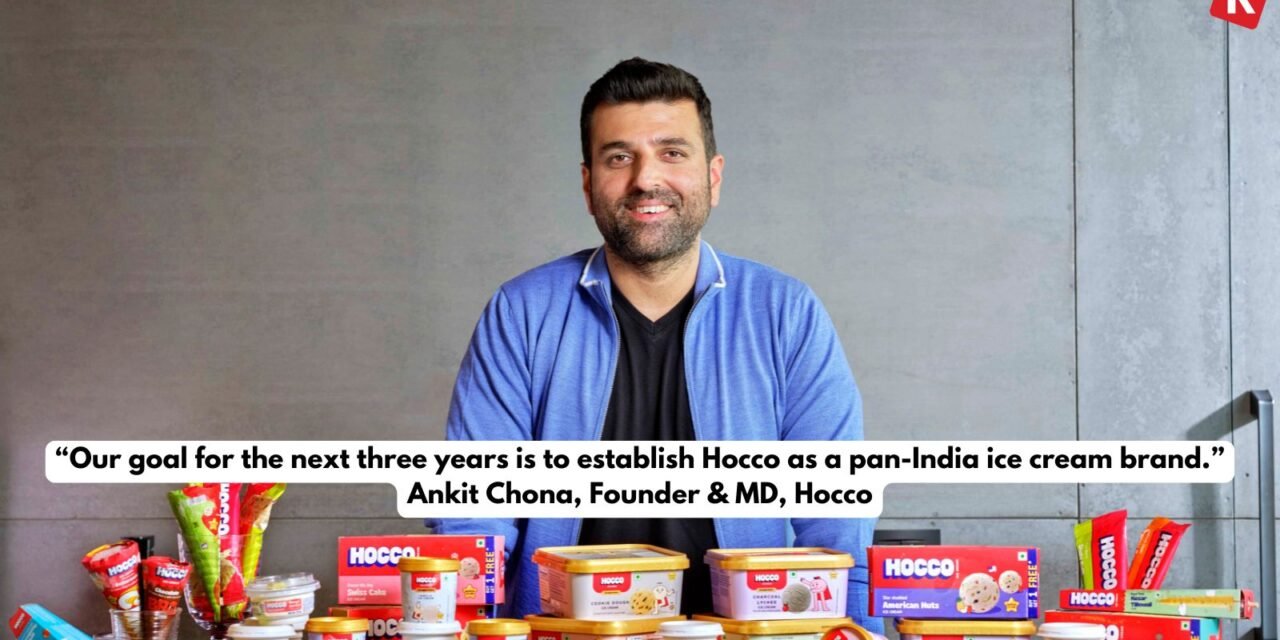
“Our goal for the next three years is to establish Hocco as a pan-India ice cream brand, expanding aggressively but strategically. We believe that the ice cream industry in India is poised for rapid growth over the next five to ten years, and we aim to be a key player in this evolution,” he concluded.